
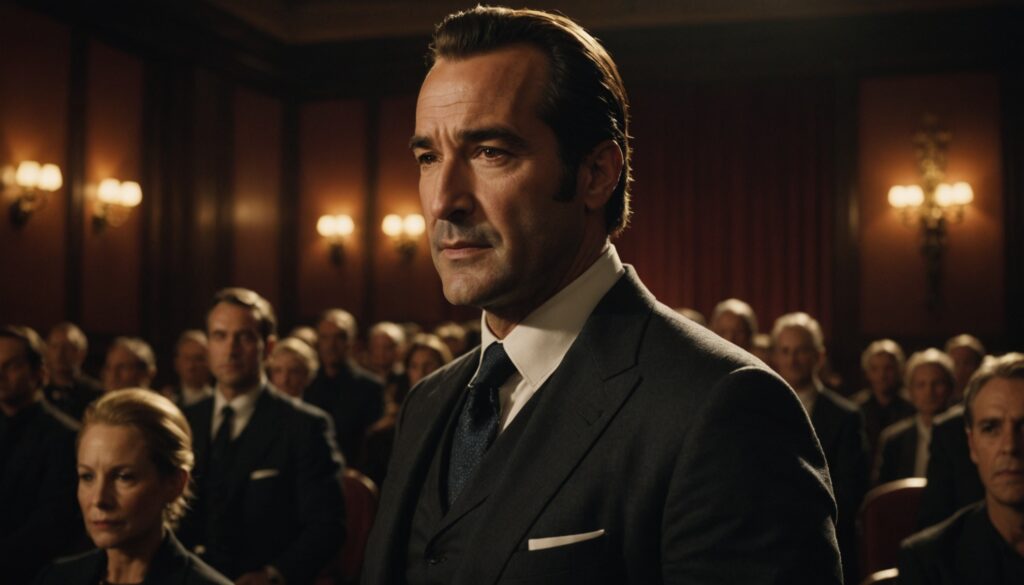
The film Les Rayons et les Ombres, carried by Jean Dujardin, sheds a new light on a complex figure of the 20th century through the nuanced gaze of cinema. Released in March 2026, this historical drama focuses on the lights and contrasts of a troubled era, where pacifist engagement can waver under the pressures of reality. Dujardin’s role, portraying Jean Luchaire, unfolds a story where convictions and compromise intertwine on the big screen. This film aims to question:
- The complexity of personal choices in wartime.
- The limits and contradictions of pacifism faced with the Occupation.
- The tension between public image and private responsibility.
- The role of memory in reconstructing the historical narrative.
- The role of cinema in representing this gray area through a major actor.
Let us dive together into this work where Dujardin transcends his status as an actor to deliver a precious pacifist engagement, told in a drama that allows room for prolonged time and deep reflection on history.
A historical drama at the crossroads of the lights and shadows of the Occupation
Les Rayons et les Ombres unfolds over 3h15 of dense and rich narration, following the contrasting path of Jean Luchaire, journalist and committed publisher, in occupied France. The film, produced with an ambitious budget of 30 million euros, relies on meticulous reconstruction to finely restore the historical, political, and social context. Its strength lies in the depth of its characters and the complexity of their motivations, far from simplistic patterns.
Jean Luchaire is first presented as a convinced pacifist, engaged in a struggle for European peace with Otto Abetz, a German diplomat played by August Diehl. Their bond, initially founded on a common ideal, cracks with the outbreak of war, symbolizing the brutal break between hope and the reality of conflict. Luchaire’s trajectory illustrates the ambivalence of a man whose will to avoid war drifts towards engagement in the Collaboration, laying bare the fragility of convictions in the face of historical catalysts.
At the same time, the rising career of Corinne Luchaire, portrayed by Nastya Golubeva, offers another dramatic perspective. An adored actress, confronted with the overwhelming weight of suspicion and public expectations, she embodies the youth filled with ardor but also the difficulty of preserving integrity in a context of constant surveillance. These parallel stories create a constant interplay of lights and shadows where the intimate and political intersect.
Here are some key elements that the film highlights:
- A renewed historical perspective, anchored in real facts but enhanced by fiction.
- A staging alternating private scenes and public moments, revealing the contradictions of the era.
- The ambiguous relationship with the Collaboration, explored without manichaeism but with a concern for historical truth.
- The way cinema captures the “gray areas” of morality in wartime.
- An emphasis on psychological, social, and political tensions through a demanding cast.
This fresco is as much concerned with representing the great historical decisions as with the micro-history of souls in torment, illustrating human complexity under a beam of contrasts
Jean Dujardin confronted with a historical role: embodying ambiguity and pacifist engagement on the big screen
Taking on the role of Jean Luchaire is a major acting challenge for Jean Dujardin. This is not a traditional hero role, but that of a man caught in the snares of an era, a pacifist engagement severely tested. Dujardin delivers a performance where charisma becomes a narrative tool, not seeking to justify or glorify, but to expose the progressive mechanics of a political and moral shift.
The cinematic method highlights lights on difficult truths, sequences where public images confront private dilemmas. The double game between Luchaire and Abetz, the actor emphasizing tension in each look, each silence, illustrates a murky zone where speech holds political weight but also a heavy emotional charge. Dujardin thus succeeds in humanizing a character often caricatured, inviting the viewer to go beyond easy labels.
The filming also benefited from close collaboration between Xavier Giannoli, a director used to this type of drama, and his lead actor, to bring this long-breath narrative to life. After their success with Illusions perdues, their partnership demonstrates continuity in deep analysis and staging of struggles for influence, here extended to a historical context with major geopolitical stakes.
Here are the reasons why Dujardin’s engagement in this project is precious:
- A subtle performance that avoids caricaturing the collaborator man.
- An interpretation that questions the viewer on choices at the limits of reason.
- The symbolic significance of this pacifist engagement embodied on screen.
- Shedding light on the making of public image in a troubled period.
- An immersion into the psychology of a pressured character.
This performance marks a notable step in Dujardin’s career, giving the film unprecedented credibility and a capacity to resonate in collective memory these essential questions about war, peace, and responsibility.
The revisited historical stakes: collaboration, collective memory, and the gray areas of pacifism
The film offers a rigorous historical framework relying on the dramatic figure of Jean Luchaire, a man executed in 1946 for collaboration, and that of his daughter Corinne, an actress whose career was marked by the war. This dual biography sheds light on the complexity of human and political relations during the Occupation, torn between pacifist ideals and the imperatives of an invading regime.
Luchaire’s real story, promoter of the Nouveaux Temps in 1940, shows how weighty choices can lead to a downfall with tragic consequences. The film, much more than reconstruction, scrutinizes deep motivations, illustrating that pacifism sometimes slips into compromise when external pressures become oppressive.
Collective memory keeps conflicting traces of this period, where the boundary between patriotic act and betrayal is not always clear. The film summons this ambivalence and invites reconsideration of the tragic mechanics of these perilous commitments. The staging thus stretches time to foster empathy without excusing.
Here is a summary table of main historical figures and their trajectory in the film:
| Character | Historical role | Played by | Role in the narrative |
|---|---|---|---|
| Jean Luchaire | Journalist, collaborationist press owner | Jean Dujardin | Protagonist, illustration of compromised pacifism |
| Corinne Luchaire | Actress, daughter of Jean Luchaire | Nastya Golubeva | Representation of youth under pressure and gray areas |
| Otto Abetz | Reich Ambassador in Paris | August Diehl | Diplomatic face of the Occupation, revealing tensions |
The treatment reserved for these characters highlights tensions between memory and history, suggesting that truth often lies halfway between light and shadow. This engaged historical portrait can enrich our understanding of the past.
Corinne Luchaire and youth at war: weight of gazes and intimate struggles under the spotlight
Through the character of Corinne, the film exposes the conflicts of a generation plunged into turmoil. Her path as an actress confronted with collective judgment sheds light on an often neglected aspect: how artists of the time had to navigate between their calling, political constraints, and social pressure.
Corinne Luchaire, portrayed intensely by Nastya Golubeva, must face the fear of being perceived as a collaborator while she fights to maintain her own identity. This personal story opens a window onto the side effects of war on cultural life, and how public recognition can become a source of anxiety rather than relief.
The film highlights internal tensions, but also the limits imposed by history: despite her fame, Corinne suffers a condemnation of national indignity after the conflict, a dramatic symbol of the weight of collective memory. Her autobiography “Ma Drôle de vie,” published in 1949, serves as a backdrop to this portrait without constraining the film to a too rigid reading.
Again, the character’s evolution illustrates the difficulty of finding light in the shadow of events, and underlines the emotional charge accompanying human trajectories when the political past intrudes on intimacy. This treatment offers a precious female perspective on an era still haunted by these dualities.
- The impact of public gaze on artists’ lives in wartime.
- The shifting boundary between personal choice and collective judgment.
- The lasting consequences of political stigmas on a career.
- The narration of a youth balanced between hope and repression.
- Cinema’s capacity to convey these psychological nuances.
Production and staging: a rare breath and marked cinematic ambition
The film’s technical dimension testifies to a will to go beyond simple historical reconstructions to offer a profound work. Produced by Gaumont, this feature fiction benefits from an experienced artistic team. The extended editing and measured pace leave room for silences, discomfort, and questioning, coexisting with crowd scenes as impressive as intimate moments.
With screenwriters like Jacques Fieschi, Xavier Giannoli, and Yves Stavrides, the narration succeeds in articulating historical mechanics with the tragic share of the Luchaire family. The significant budget guarantees visual and sound quality worthy of Europe’s greatest frescoes. Light and shadow are used to reinforce dramaturgy, creating an aesthetic that emphasizes both the grandeur and fragility of the characters.
The choice of an extensive cast extends this ambition. Beyond the main trio, collaborators like Vincent Colombe and André Marcon bring additional density that enhances realism and psychological depth. This casting structure supports the film’s message while avoiding exclusive dependence on star power, thus ensuring a quality narrative balance.
In the evolution of French cinema, Les Rayons et les Ombres can be seen as a milestone that calls for deeper reflection on how collective history is approached. The presentation at a preview at the Forum des Images also testifies to a desire to open a dialogue space beyond the screen.
- A staging that favors long time to deepen dilemmas.
- The importance of a substantial budget to faithfully reconstruct the era.
- The strategic role of a diverse and solid cast.
- A national production with significant artistic demand.
- An approach mixing historical reflection and emotion.