
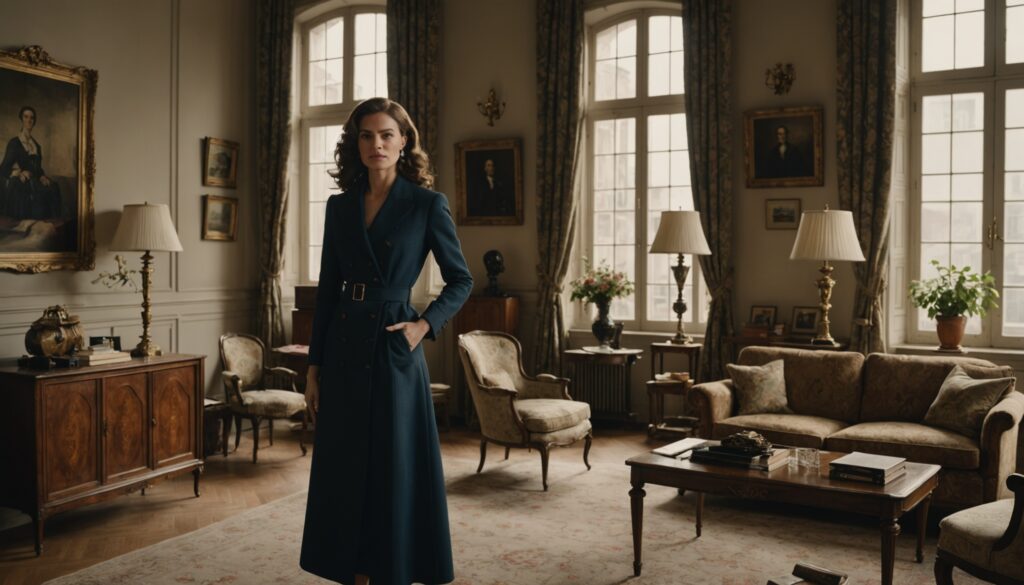
Le Crime du 3ème Étage marks the highly anticipated return of Laeticia Casta to the big screen in a French film blending suspense and humor. This unusual police comedy, characterized by its Hitchcockian DNA, promises a duo of amateur investigators who will play with our nerves while making us smile. Distributed by SND and carried by a stellar cast, this project, directed by Rémi Bezançon, reveals a story of observation and suspicion, set in a simple but captivating environment: a Parisian building and its secrets on the 3rd floor. The film will be released in theaters on March 11, and its official trailer, already revealed, efficiently immerses us in this universe.
Here are the key points to discover below:
- The major role of Laeticia Casta and her character linked to Hitchcock
- A plot between marital drama and thriller, combined with a comedic atmosphere
- A solid duo of actors, between Gilles Lellouche and Guillaume Gallienne
- Cinematic references and the explicit tribute to Rear Window
- Narrative and technical stakes that distinguish this French film in the 2026 cinema landscape
Let’s delve into each of these points to give your perspective a comprehensive view of this cinematic event.
The return of Laeticia Casta in Le Crime du 3ème Étage: a character under Hitchcockian influence
Laeticia Casta makes a remarkable return to cinema by playing Colette, a film professor specialized in Alfred Hitchcock’s work. This choice is not incidental. Her character is a true bridge to the reference film Rear Window, to which the script pays explicit homage. By playing a teacher who knows perfectly the codes of suspense and framing, Laeticia Casta invites the viewer to watch the film with an expert eye, while leaving room for doubt about the reality of the events she observes.
This role, both intellectual and emotional, is an ideal playground for Laeticia, who must express curiosity, anxiety, and perseverance of a woman fascinated by observing her environment. Colette thus becomes the central engine of the narrative tension, mixing her couple life with the obsession to understand what is going on on the 3rd floor of her building.
Colette’s character embodies several dimensions:
- A true passion for cinema and thriller, which influences her vision and interpretation of the events
- An amateur detective role that questions the limits between intuition and proof
- An intimate portrait exploring the impact of an investigation on an ordinary couple
This construction opens fertile ground for the thriller to become a subtle comedy, where the line between real and imaginary remains blurred. Here we find a mastered art of suspense, both playful and intelligent.
A plot centered on the couple and the investigation: the duo Laeticia Casta-Gilles Lellouche facing suspense
The heart of the film relies on the dynamic between Colette (Laeticia Casta) and her husband François, played by Gilles Lellouche, who portrays a writer of historical-police novels. This alliance between a film professor and a thriller author sets an original framework, where the two modes of reasoning clash to build an improvised investigation.
The paradox is palpable:
- Colette, driven by passionate intuition, pushes towards suspicion and action
- François takes a more cautious position, playing the skeptic who relativizes the observations
- An unstable balance that generates humor, tension, and complicity in a relationship put to the test
Opposite them, Guillaume Gallienne plays Yann Kerbec, the mysterious neighbor on the 3rd floor, around whom the suspicions of an unsolved murder revolve. The character is presented as enigmatic, but the lack of tangible evidence offers the viewer a unique experience where doubt becomes the main driver of the plot.
The film’s trailer, lasting 2 minutes and 14 seconds, perfectly illustrates this narrative mechanism. For example, the phrase “I’m sure something serious happened. I really think he killed his wife” sums up this tension between intimate conviction and lack of certainty.
The actors’ performance conveys well this grey area where ordinary life and thriller intertwine daily. This blend of drama and comedy reveals subtle nuances that promise an experience both entertaining and introspective for the viewer.
A tribute to Rear Window: mirror between classic cinema and narrative modernity
Le Crime du 3ème Étage proudly claims its roots in the Hitchcockian classic Rear Window. This choice of reference manifests itself on several levels:
- Colette’s character, who precisely teaches this film, makes the source work an object of dialogue with the viewer
- The script relies on staging distant observation, where the mystery is shaped by the subjective perspective of a witness
- The very idea of the original title, Bazaar, is a direct nod to a magazine visible in Hitchcock’s film
This approach integrates the thriller into a modern conversation with classic cinema while renewing itself with a lighter treatment, tinged with humor and a touch of self-mockery. The viewer is invited to take part in this homemade investigation, where every little detail observed can influence the truth.
The tribute also influences the visual and sound design. With Pierre Cottereau in charge of cinematography, the light becomes a character in its own right, playing with shadows and reflections, reinforcing the mysterious and muffled atmosphere of the film. The music composed by Laurent Perez del Mar creates a balance between tension and lightness, essential to keep the viewer on edge without unnecessary heaviness.
This genre blend gives its full flavor to this new French release, which thus recovers a vintage soul in a resolutely contemporary staging, where the characters themselves engage with cinephile culture and its effects on reality.
Technique and production: artistic choices that bring the film’s atmosphere to life
For a film like Le Crime du 3ème Étage, technique largely precedes emotion. Rémi Bezançon, an experienced director, trusts a perfectly seasoned technical team to create an immersive atmosphere:
| Technical Element | Detail |
|---|---|
| Cinematography | Pierre Cottereau — mastery of light and shadow play, focus on urban texture |
| Music | Laurent Perez del Mar — balancing suspense and lightness, enhances narrative tension |
| Production | Jerico Films — specialist in quality French films, solid creative support |
| Distribution | SND — national and international network, ensuring wide theatrical visibility |
| World Premiere | International Film Festival Rotterdam — sign of ambitious critical recognition |
These collaborations strengthen the film’s status, ensuring an aesthetic consistent with its narrative content. The light and music directly contribute to making the viewer feel the pressure of a magnifying glass placed on an apparently mundane daily life but full of mysteries. This attention to detail notably supports this atmosphere between drama and comedy, typical of making this film a must-see.
The cast and human stakes: a new dynamic in French cinema in 2026
In the current context of French cinema, Le Crime du 3ème Étage highlights a cast that confirms a qualitative turn towards more subtle and intimate stories. Gilles Lellouche, Laeticia Casta, and Guillaume Gallienne form a recognized but above all complementary trio, playing on emotions and unspoken words.
Their chemistry, which appears palpable right from the trailer, brings real depth to the drama and thriller intertwined in the film. This alchemy is strengthened by the collaboration between Rémi Bezançon and Gilles Lellouche, reunited twenty years after their first joint work on “Ma vie en l’air” (2005), which establishes solid creative trust on this project.
The film will likely fuel the interest of aficionados and more seasoned cinephiles, eager to follow the evolutions of French cinema while appreciating a subtle plot carried by charismatic actors. This leading trio also highlights the human stakes that go beyond the investigation: marital tensions, doubts, and fears projected onto what surrounds us.
The casting thus reflects a strong desire to anchor a new French release in a balance between thriller and comedy.
For those who like to explore the varied sectors of cinema, the parallel with other astonishing adaptations, such as the 80s crime films or recent works, is always enriching.