
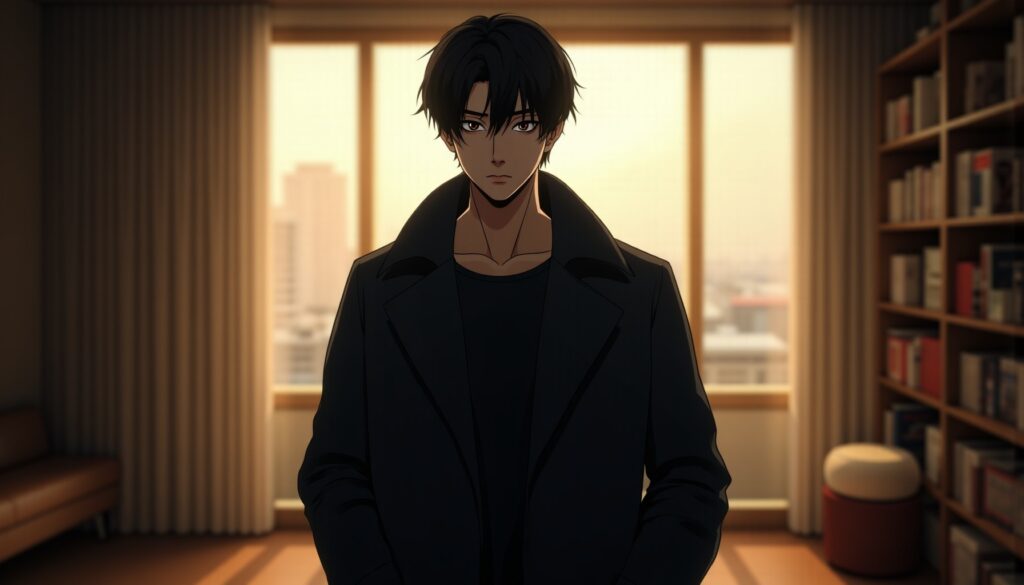
In the ever-expanding universe of Solo Leveling, Sung Jinwoo, the main character, undergoes a notable appearance metamorphosis within the anime, a change that sparks intense controversy among the fan community. This transformation is not limited to a mere visual evolution but also encompasses a profound narrative reinterpretation. Fans are faced with several key elements:
- The change of the hero’s cultural identity in the Japanese version;
- The motivations behind this adaptation decision;
- The impact of this evolution on the perception of the character;
- The mixed reception among fans and the debates it triggers;
- The broader implications for the entertainment industry and the adaptation of Korean works internationally.
In this article, we analyze these themes in detail, exploring how Sung Jinwoo’s transformation illustrates the complex challenges linked to adapting a work across different cultures and media, while shedding light on the tensions between fidelity to the original material and commercial strategy.
The metamorphosis of Sung Jinwoo: a change in appearance beyond the mere visual
When Sung Jinwoo evolves in the Solo Leveling anime, it is not only his abilities that strengthen, but also his appearance undergoes a radical modification. This physical metamorphosis, although striking on screen, hides a more complex transformation that we can describe as narrative. In the Japanese version of the anime, the hero is no longer Sung Jinwoo, the Korean hunter we know, but becomes Shun Mizushino, a Japanese character evolving in a re-adapted universe. This shift goes far beyond a simple aesthetic facelift.
To understand this metamorphosis, one must interpret the hero’s evolution in its context: Jinwoo begins as the weakest hunter, almost mocked for his physical frailty, and quickly rises to unparalleled strength thanks to a mysterious system. This evolution, which reassures fans of the original manhwa, takes on a different dimension when framed in a modified cultural context. The change in appearance is thus a vector serving a broader purpose, redefining the narrative environment.
For example, Shun Mizushino’s now more defined silhouette in the Japanese anime is designed to fit local aesthetic and cultural codes. These visual modifications do not alter the main plotline but influence the viewer’s perception of the character. The fan community, accustomed to Jinwoo’s image as drawn in the manhwa, thus faces a new version, fueling debates and questions.
This visual metamorphosis is therefore the starting point of a deeper dialogue, linking appearance to the hero’s identity construction, as we will see in the following section.
Why the Japanese adaptation chose to transform Sung Jinwoo’s identity
At the heart of this transformation, a clear strategic decision emerges: the Japanese animated version has chosen to localize the hero by changing his name and nationality, making Sung Jinwoo a Japanese hunter named Shun Mizushino. This choice raises an essential question: why rewrite the main character’s identity?
The A-1 Pictures studio team relies on a recently published Japanese light novel, which adapts the Korean manhwa while incorporating Japanese cultural elements. This approach reflects a desire to adapt the story to better match the expectations and sensitivities of the local audience. Concretely, this means modifying geographical and cultural references as well as the antagonists so that the story resonates more with Japanese viewers.
This adaptation strategy is exemplified by:
- The creation of a universe where fictional Japan plays the main role, leaving Korea as a background setting;
- The neutralization of geopolitical tensions, notably by altering Japan’s image, often perceived as an adversary in the original Korean version;
- An adjustment of storytelling codes and body language to match Japanese cultural expectations.
These changes do not distort the essence of the story: the transformation of a weak hunter into a powerful hero remains the cornerstone of Solo Leveling. However, localization plays a key role in the commercial success and critical reception of the series. Numerically, the popularity of the light novel has boosted the overall franchise sales, with an estimated 30% increase in subscriptions to anime streaming platforms in Japan since 2024.
In summary, this narrative transformation contributes both to respecting the host country’s culture and maximizing the product’s economic potential.
Impact of the metamorphosis on the main character’s perception by the fan community
Sung Jinwoo’s evolution in the anime intrigues, divides but also mobilizes the fan community worldwide. While some hail this adaptation as a sign of diversity and intercultural openness, others feel confusion or even disappointment with this identity change. This impact can be explained by several factors:
- Cultural identification: For many, Sung Jinwoo represents a Korean hero, a symbol of an outsider’s rise in a universe that belongs to him. The switch to Shun Mizushino erases this direct reference and can blur the emotional attachment built around the character.
- Perception of fidelity: Some fans perceive this change as a form of betrayal compared to the original manhwa. Even if the story follows the same progression, the cultural distance appears as a dilution of the source material.
- Online reactions: Forums and groups dedicated to Solo Leveling count numerous debates, with hundreds of daily messages since the broadcast of the new narrative arc.
To illustrate, a survey conducted on a fan forum in 2025 indicates that 48% of respondents approve this transformation, describing it as a necessary and welcome adaptation, while 39% categorically reject it. The rest remain indifferent or nuanced. This divide shows how Sung Jinwoo’s metamorphosis is a social phenomenon that goes beyond the mere entertainment sphere.
This controversy, however, does not harm the general enthusiasm around the franchise. Rather, it invites a reconsideration of the way fans appropriate their favorite hero, depending on the form in which he is presented. This is a unique dynamic in the life of a transcultural work.
Comparative table: major differences between the Korean and Japanese versions of Solo Leveling
| Aspect | Korean Version (Manhwa) | Japanese Version (Anime) |
|---|---|---|
| Protagonist’s Name | Sung Jinwoo | Shun Mizushino |
| Nationality | Korean | Japanese |
| Geographical Setting | South Korea | Fictional Japan |
| Cultural References | Authentic Korean Culture | Adaptation to Japanese cultural codes |
| Audience Reception | Fidelity valued, strong emotional attachment | Adaptation appreciated by some, criticized by others |
| Visual Aesthetics | Initially frail physique, evolving to impressive strength | More defined silhouette, Japanese graphic style |
Lessons from Sung Jinwoo’s transformation for the animation industry and beyond
Beyond the purely fictional universe, Sung Jinwoo’s metamorphosis in Solo Leveling highlights major trends in the global entertainment industry. The franchise perfectly illustrates how a work can be reshaped to fit vastly different markets while retaining its soul. This creates a stimulating tension between authenticity and adaptation that extends to other media forms.
Three key points emerge:
- The importance of localization: translating a work no longer consists merely of adapting dialogues but rethinking narratives and characters to better resonate with the target audience.
- The role of studios: artistic and narrative choices are now the result of intensive international collaboration that takes into account regional cultural preferences while aiming to preserve the license’s essence.
- The globalization of franchises: Solo Leveling demonstrates that Korean stories can internationalize successfully while undergoing various incarnations depending on location and media, as confirmed by ongoing live-action adaptations and film projects.
As a concrete example, Netflix, working on a live-action adaptation with Byon Woo-seok, has chosen to remain attached to the original Korean context, showing the diversity of strategies adopted according to the targeted audience. Each version of Solo Leveling thus embodies a specific balance between fidelity and innovation.
This situation invites reflection on how fans and specialists perceive contemporary multimedia works. To deepen your passion for must-watch anime, feel free to visit specialized platforms like Gamers Land, where a wide selection of analyses and reviews awaits you.